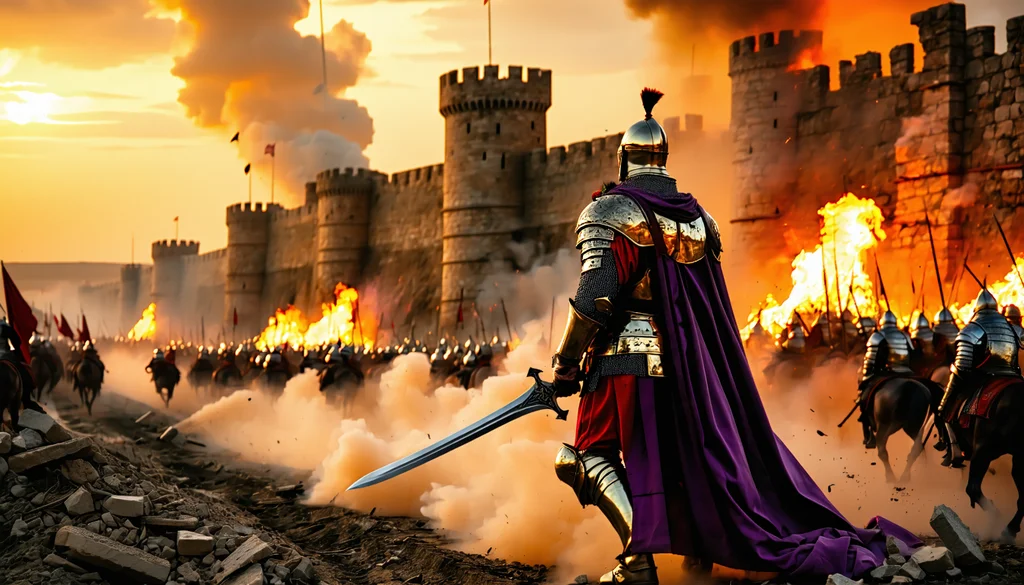
Fall of Constantinople
Sultan Mehmed II's Ottoman forces breach the Theodosian Walls after a 53-day siege, conquering Constantinople and ending the Byzantine Empire — the last surviving continuation of the Roman state that began with Caesar's crossing of the Rubicon 1,502 years earlier. Emperor Constantine XI Palaiologos, the last Roman emperor, dies fighting in the final assault. The 21-year-old sultan's unprecedented artillery train, centered on Orban's Great Bombard — a 27-foot cannon firing 600-pound stone balls — marks the first time gunpowder artillery decisively destroys medieval fortifications, ending the age of the walled city. The garrison of roughly 7,000 defenders (5,000 Greeks and 2,000 Genoese and Venetian volunteers under Giovanni Giustiniani) falls to an Ottoman force of 80,000-100,000 troops attacking in three waves: irregular bashi-bazouks, Anatolian regulars, then elite Janissaries. The turning point comes when Giustiniani is wounded and carried from the walls, causing panic among the defenders just as Ottomans discover the unlocked Kerkoporta postern gate. The fall triggers a Greek scholarly diaspora — Bessarion, Argyropoulos, Chalcondyles and others carry classical manuscripts of Plato, Aristotle, and Homer westward to Venice and Florence, accelerating the Italian Renaissance. Ottoman control of eastern Mediterranean trade chokepoints incentivizes Portugal and Spain to seek sea routes to Asia, contributing to the Age of Exploration. Widely cited as the conventional end of the Middle Ages, the event severs the last institutional link to the ancient Roman world and closes a continuous political lineage stretching from 753 BC.