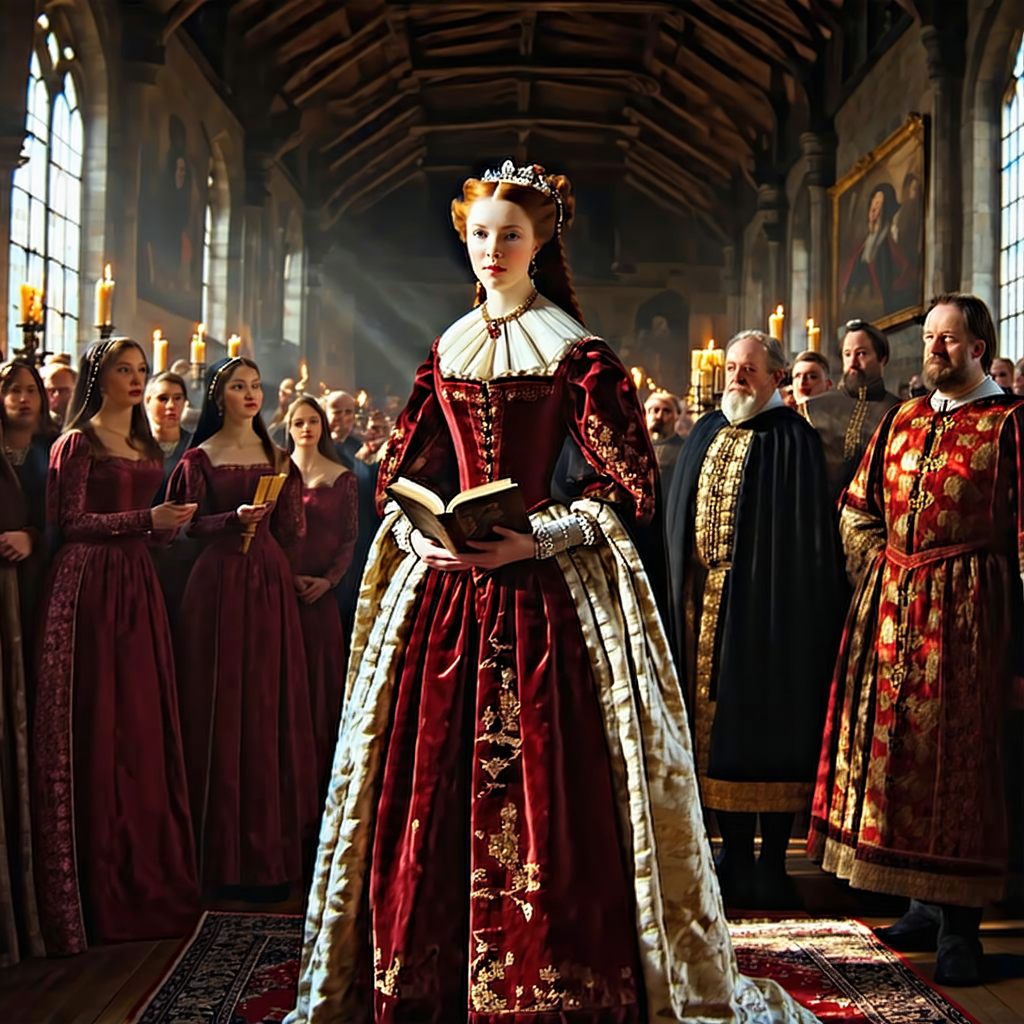
Accession of Elizabeth I
Elizabeth I receives the news of her sister Mary I's death at Hatfield House, surrounded by her advisors and courtiers, marking the beginning of her reign and the Elizabethan era.
Setting
The Great Hall of Hatfield House, a grand Tudor mansion surrounded by sprawling autumn gardens. The hall features high ceilings with exposed wooden beams, large leaded glass windows, and a massive stone fireplace. The room is adorned with rich tapestries depicting historical and biblical scenes.
Characters
The figures in this scene as an entity network — co-presence links everyone in the moment; speakers who trade lines are bound tighter. Turn the resolution dial to reveal depth the engine actually computed.
TNGF
SELECTED
Elizabeth I
primary
A striking young woman of 25 years with a slender yet regal bearing, pale complexion, and piercing dark eyes that seem to take in every detail. Her most distinctive feature is her flame-red hair, worn loose in this private moment rather than in her later signature elaborate styles. Her hands are delicate but strong, one resting on an oak table for support as she processes the news.
William Cecil
primary
A middle-aged man of slight but wiry build, with a sharp, intelligent face framed by a neatly trimmed beard and thinning brown hair. His piercing eyes convey both wisdom and a calculating nature, with deep lines suggesting years of careful thought and political maneuvering.
Lady-in-Waiting
secondary
A noblewoman in her late twenties, with a slender yet graceful build. Her fair complexion is complemented by high cheekbones and delicate features. Her auburn hair is neatly tucked beneath her French hood, with a few loose curls framing her face. Her hands are clasped together, revealing fine, unblemished skin indicative of her noble status.
Herald
secondary
A lean man in his early thirties, with a sharp nose and deep-set eyes that suggest many miles traveled. His face is weathered from outdoor duties, and his dark hair is cropped short in the military style favored by Tudor messengers. His posture is rigid, trained for formal announcements.
Guard Captain
background
A tall, broad-shouldered man in his late 30s with a weathered face, a closely trimmed beard, and piercing blue eyes that scan the room with military precision. His hands are calloused from years of wielding weapons, and he stands with the upright posture of a seasoned soldier.
Dialog
Herald
By your leave, Your Grace, I bear tidings most solemn - the late Queen Mary has passed unto God's mercy this seventeenth day of November.
Elizabeth I
We thank you for your faithful service. Let all present bear witness - this is the Lord's doing, and it is marvelous in our eyes.
William Cecil
Your Grace, prima facie - that is to say, at first appearance - we must consider the immediate sowing of stability. The Council will look to you as the wheat looks to the sun after winter.
Elizabeth I
The wheat shall have its sun, good Cecil, but let us not reap before the harvest is ripe. What news from London?
Herald
If it please Your Grace, the city waits with bated breath. The bells of St. Paul's remain silent by order of the Lord Mayor.
William Cecil
The silence speaks volumes, Your Grace. When the proclamation is made, we must have the trained bands ready - the papist factions may prove... unruly.
Elizabeth I
Then let them hear this unruly truth - England shall have but one mistress, and no master. Prepare my horse. We ride to London at dawn.
Chat with Characters
Causal neighbors · 57 linked moments
D
1558
· contemporaneous
D
1558
· contemporaneous
C
1559
· same figure
T
1560
· same figure
T
1560
· same figure

1559
· same figure
T
1560
· same figure
T
1560
· same figure
T
1559
· same figure
E
1554
· same era
E
1554
· precedes

1553
· same era
D
1558
· contemporaneous
D
1558
· contemporaneous
A
1559
· same era
C
1559
· same era
T
1550
· same era
D
1553
· same era
T
1551
· same era
T
1550
· same era
E
1554
· same era
S
1557
· same era
T
1568
· same era
E
1557
· same era
M
1553
· same era
1559
· same era
T
1550
· same era
D
1553
· same era
A
1559
· precedes
C
1559
· precedes
T
1568
· precedes
1559
· precedes
T
1550
· follows
D
1553
· follows
T
1551
· follows
T
1550
· follows