Treaty of Versailles
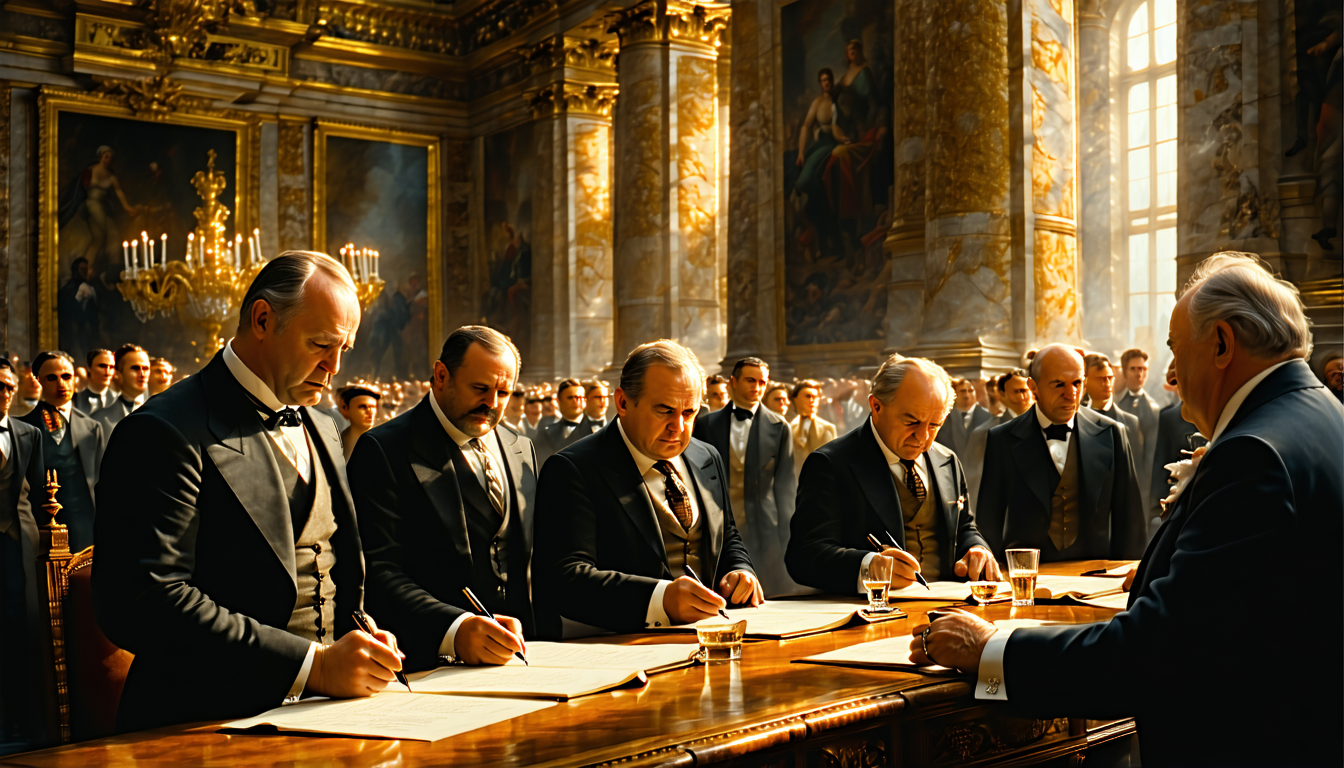
The signing of the Treaty of Versailles, marking the end of World War I, as Allied leaders and German delegates gather in the Hall of Mirrors to formalize peace terms that impose harsh penalties on Ge
Setting
The Hall of Mirrors in the Palace of Versailles, France, a grand and opulent gallery adorned with 17 mirrored arches opposite 17 windows overlooking the palace gardens. The room is filled with dignitaries, diplomats, and military officials from the Allied Powers and Germany.
Characters
The figures in this scene as an entity network — co-presence links everyone in the moment; speakers who trade lines are bound tighter. Turn the resolution dial to reveal depth the engine actually computed.
TNGF
SELECTED
Woodrow Wilson
primary
A tall, lean man in his early 60s with a gaunt, angular face, high forehead, and piercing gray-blue eyes behind round spectacles. His posture is upright but slightly stiff, with a noticeable tension in his jawline. His thinning gray hair is neatly combed back.
Georges Clemenceau
primary
A wiry, middle-aged man with a sharp, angular face framed by a neatly trimmed white beard. His piercing dark eyes convey both intelligence and a relentless determination. His posture is upright, exuding authority despite his slight frame.
David Lloyd George
secondary
A middle-aged Welshman of average height with a wiry build, sharp features, and a neatly trimmed mustache. His piercing blue eyes convey both shrewdness and weariness, framed by deep-set wrinkles from years of political maneuvering.
German Diplomat
secondary
A middle-aged man with a gaunt face, deep-set eyes, and a rigid posture that betrays his internal tension. His dark hair is streaked with gray, combed back severely, and his pale complexion suggests sleepless nights. His thin lips are pressed into a tight line, and his jaw is clenched.
French Officer
background
A middle-aged military aide, approximately 45 years old, with a lean and upright build that reflects his military discipline. His face is clean-shaven with sharp, angular features, and his dark brown hair is trimmed short in a regulation military style. His piercing blue eyes scan the room with a vigilant and unyielding gaze.
Dialog
Woodrow Wilson
Gentlemen, while I concede the necessity of reparations, we must consider whether these terms may sow seeds of resentment that could—as it were—undermine the very peace we seek to establish.
Georges Clemenceau
Resentment? After what they have done to France? Non, monsieur. Let them choke on their pride—it is a lighter burden than our dead.
David Lloyd George
Now see here—practically speaking, we must steady the ship. Too harsh, and we risk capsizing Europe’s future; too lenient, and our own people will revolt.
Georges Clemenceau
Steady the ship? Bah! Germany torpedoed ours—let them bail water for a century.
Woodrow Wilson
If we reduce this to vengeance, we betray the principles upon which the League of Nations must stand.
David Lloyd George
Principles alone won’t rebuild Flanders’ fields, Wilson. But nor will grinding Germany to dust.
Georges Clemenceau
Enough talk. The ink waits. Sign it—or let history remember who hesitated.
Chat with Characters
Causal neighbors · 372 linked moments
T
1919
· contemporaneous
T
1919
· same location
T
1919
· same figure
T
1919
· same era
T
1919
· follows
T
1920
· same era
T
1920
· follows
B
1917
· same era
B
1917
· precedes
G
1918
· same era
G
1918
· precedes
A
1918
· same era
A
1918
· precedes
T
1919
· same era
T
1919
· follows
T
1919
· same era
T
1919
· follows
T
1920
· same era
T
1920
· follows
A
1918
· same figure
O
1919
· same era
O
1919
· precedes
O
1919
· same figure
U
1917
· same figure
T
1919
· same era
T
1919
· follows
B
1916
· same era
B
1916
· precedes
B
1916
· same era
B
1916
· precedes
B
1916
· same era
B
1916
· precedes
B
1918
· same era
B
1918
· same era
B
1918
· precedes
B
1918
· precedes