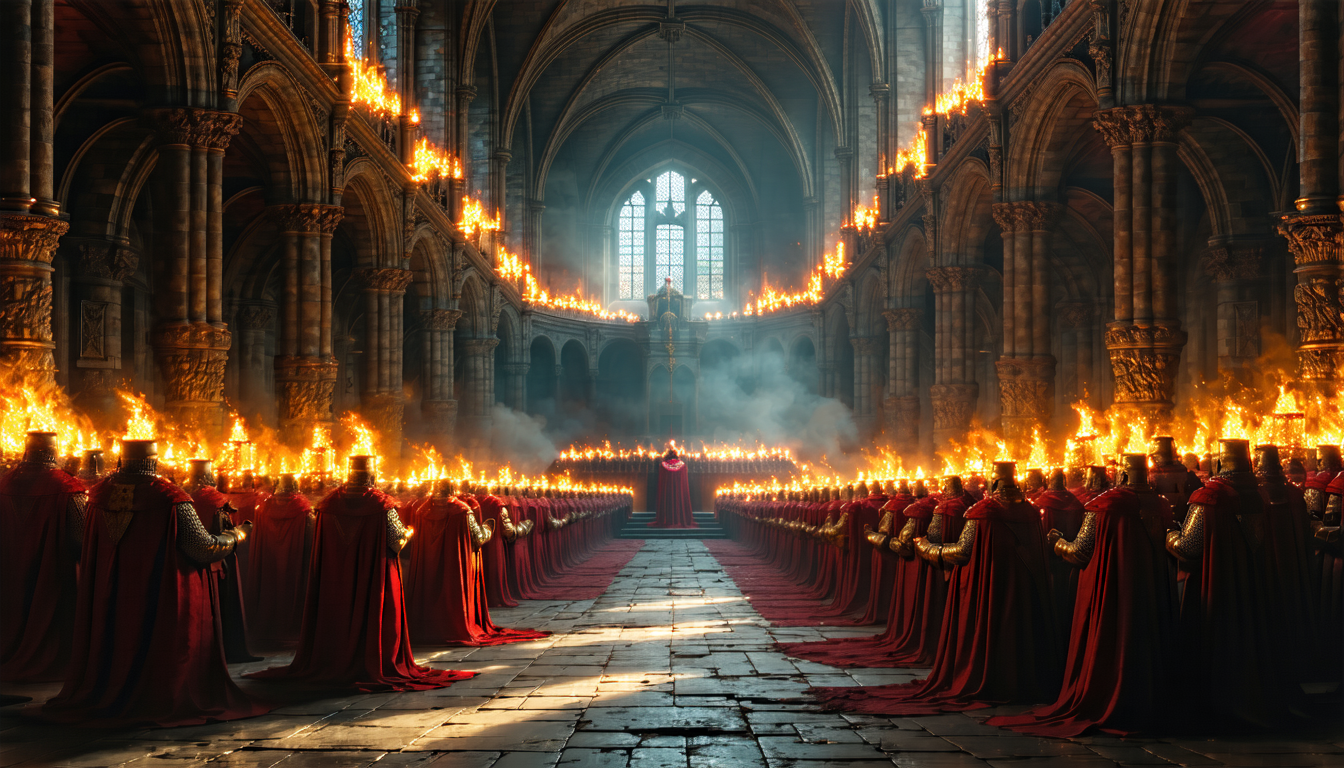
Edict of Worms
Martin Luther stands before Holy Roman Emperor Charles V and the assembled Diet of Worms, defending his writings that challenge the Catholic Church's doctrines and practices. He is asked to recant his
Setting
The grand hall of the Bishop's Palace in Worms, Germany, with high vaulted ceilings and stained glass windows casting colored light onto the stone floor. The hall is arranged with a raised dais for the Emperor and his advisors, while the rest of the space is filled with bishops, nobles, and attendants.
Characters
The figures in this scene as an entity network — co-presence links everyone in the moment; speakers who trade lines are bound tighter. Turn the resolution dial to reveal depth the engine actually computed.
TNGF
SELECTED
Martin Luther
primary
A middle-aged monk with a sturdy build, piercing eyes, and a tonsured head. His face bears the marks of intense study and conviction, with deep-set eyes and a strong jawline.
Charles V
primary
A young man in his early twenties, with a pale complexion and a serious, regal bearing. His dark brown hair is neatly trimmed, and his piercing blue eyes survey the room with authority. He has a strong jawline and a slightly aquiline nose, giving him a commanding presence despite his youth.
Archbishop of Trier
secondary
A tall, imposing figure in his late 50s with a gaunt face, sharp cheekbones, and piercing dark eyes. His thin lips are often pressed together in disapproval, and his pale complexion contrasts with the rich fabrics of his ecclesiastical garments. His hands are long-fingered and often clasped together in a gesture of pious authority.
Imperial Guard
background
A tall, broad-shouldered soldier in his late 30s, with a weathered face and a stern expression. His piercing eyes scan the room constantly, ever vigilant. His muscular frame is clad in polished armor, and he carries a halberd with practiced ease.
Nobleman
secondary
A German prince in his mid-30s, with a lean but athletic build, sharp facial features, and a neatly trimmed beard. His piercing blue eyes scan the room with keen interest, reflecting both his noble upbringing and his intellectual curiosity.
Dialog
Charles V
Martin Luther, you stand before this assembly accused of heresy. Will you recant your writings, or do you persist in your errors?
Martin Luther
Unless I am convinced by Scripture and plain reason—for I do not accept the authority of popes and councils, for they have contradicted each other—my conscience is captive to the Word of God. I cannot and will not recant anything.
Archbishop of Trier
Do you not see how your obstinacy undermines the unity of Christendom? Your conscience is but a reed shaken by the wind, while the Church stands firm upon the rock of Peter!
Martin Luther
My lord, if I have erred, let it be shown to me from the Holy Scriptures. For it is neither safe nor right to act against conscience.
Charles V
Enough! This monk speaks with the boldness of one who thinks himself above the authority of emperors and councils. Let the record show his refusal to recant.
Archbishop of Trier
Then let him be declared a heretic and an outlaw, that all may know the price of such defiance!
Martin Luther
Here I stand. I can do no other. God help me.
Chat with Characters
Causal neighbors · 543 linked moments
P
1530
· same era
D
1521
· contemporaneous
M
1521
· contemporaneous
D
1521
· contemporaneous
D
1521
· contemporaneous
M
1521
· contemporaneous
D
1521
· contemporaneous
1521
· contemporaneous
D
1521
· contemporaneous
D
1521
· contemporaneous
E
1521
· contemporaneous
M
1521
· contemporaneous
D
1521
· same location
M
1521
· same location
D
1521
· same location
D
1521
· same location
D
1521
· same location
D
1521
· same location
D
1521
· same location
E
1521
· same location
M
1521
· same location
1555
· same figure
1517
· same figure
P
1555
· same figure
B
1547
· same figure
B
1547
· same figure
D
1521
· same figure
D
1521
· same figure
M
1529
· same figure
P
1517
· same figure

1525
· same figure
D
1521
· contemporaneous
M
1521
· contemporaneous
D
1521
· contemporaneous
D
1521
· contemporaneous
M
1521
· contemporaneous