Peace of Augsburg
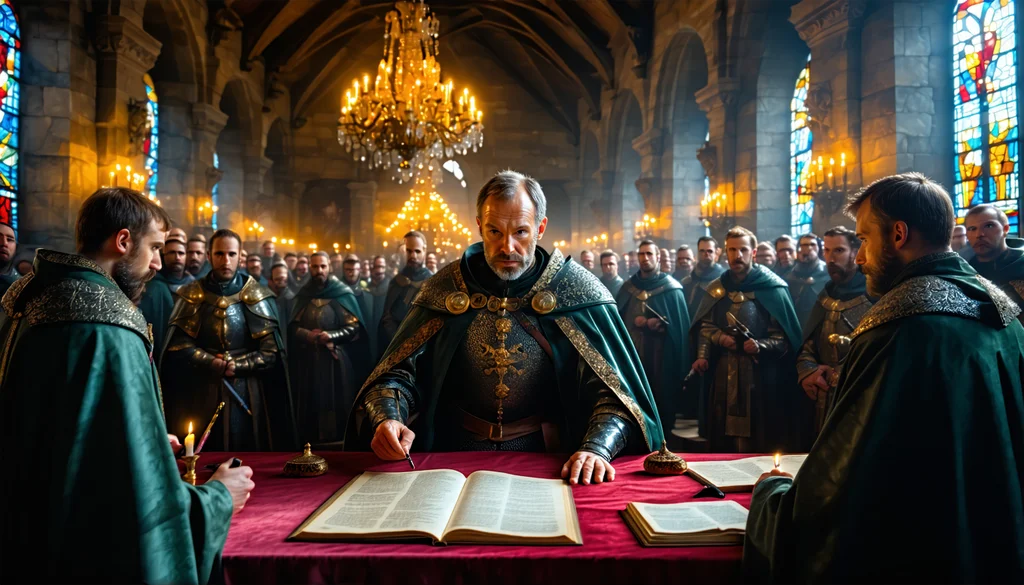
The signing of the Peace of Augsburg, a pivotal moment where the Holy Roman Empire formally recognizes the coexistence of Catholicism and Lutheranism, ending decades of religious conflict.
Setting
The grand council chamber of Augsburg Town Hall, a stately room with high vaulted ceilings and ornate wood paneling. The space is filled with delegates from the Holy Roman Empire, religious leaders, and representatives of the Schmalkaldic League, all gathered around a long oak table.
Characters
The figures in this scene as an entity network — co-presence links everyone in the moment; speakers who trade lines are bound tighter. Turn the resolution dial to reveal depth the engine actually computed.
TNGF
SELECTED
Charles V
primary
A middle-aged man of average height with a slightly stocky build, his face showing the weariness of years of rule. His dark, piercing eyes are framed by deep lines of stress and responsibility. His short, graying beard and receding hairline give him a dignified yet fatigued appearance.
Protestant Prince
primary
A tall, middle-aged man with sharp features and a neatly trimmed beard. His piercing blue eyes reflect both intelligence and wariness. His build is lean but strong, suggesting a noble accustomed to both courtly life and military campaigns.
Catholic Bishop
secondary
A middle-aged man of stout build, with a pale, clean-shaven face and deep-set, solemn eyes. His high-ranking status is evident in his well-fed frame and the rings adorning his fingers. His tonsure is neatly trimmed, and he carries himself with the weary dignity of a man accustomed to both power and compromise.
Scribe
secondary
A middle-aged man with a slight hunch, indicating years spent bent over documents. His keen eyes are framed by wire-rimmed spectacles, and his fingers are stained with ink. He has a neatly trimmed beard and short, practical hair.
Imperial Guard
background
A tall, broad-shouldered soldier in his late 30s with a weathered face and close-cropped beard. His piercing eyes scan the room with practiced vigilance. The scars on his knuckles suggest years of military service.
Dialog
Charles V
After much bloodshed and strife, we gather today not in triumph, but in solemn recognition of a necessity greater than any single conviction.
Protestant Prince
Your Majesty speaks wisely. It is indeed necessity that brings us here—the necessity of peace, and the preservation of our lands and people.
Catholic Bishop
Necessity, though bitter, must sometimes be endured for the greater good of Christendom. The Church yields not in spirit, but in temporal concession.
Charles V
Let it be known then, that by this peace, each prince shall determine the faith of his own realm—lest further strife tear asunder what remains of our Empire.
Protestant Prince
A fair and just settlement—one that grants neither victory nor defeat, but the chance for peace to take root.
Catholic Bishop
May God grant that this concession does not embolden further division, but rather restores the harmony so long absent from our lands.
Charles V
Then let this peace be signed, and may history judge it as the lesser of evils, if not the ideal we all once sought.
Chat with Characters
Causal neighbors · 293 linked moments
T
1526
· same figure
B
1547
· same era
B
1547
· precedes
P
1555
· contemporaneous
1555
· contemporaneous
P
1555
· contemporaneous
1555
· contemporaneous
P
1555
· contemporaneous
P
1555
· contemporaneous
A
1548
· same location
P
1555
· same location
1555
· same figure
P
1555
· same figure
B
1547
· same figure
B
1338
· same figure
1552
· same figure
S
1433
· same figure
A
1548
· same figure
1547
· same figure
P
1530
· same figure
P
1555
· same figure
1521
· same figure
1530
· same figure
P
1555
· same figure
1521
· same figure
A
1530
· same figure
C
1547
· same figure
D
1521
· same figure
1555
· same figure
B
1547
· same figure
B
1547
· same figure
P
1555
· same figure
C
1530
· same figure
D
1521
· same figure
P
1517
· thematic
D
1521
· same figure