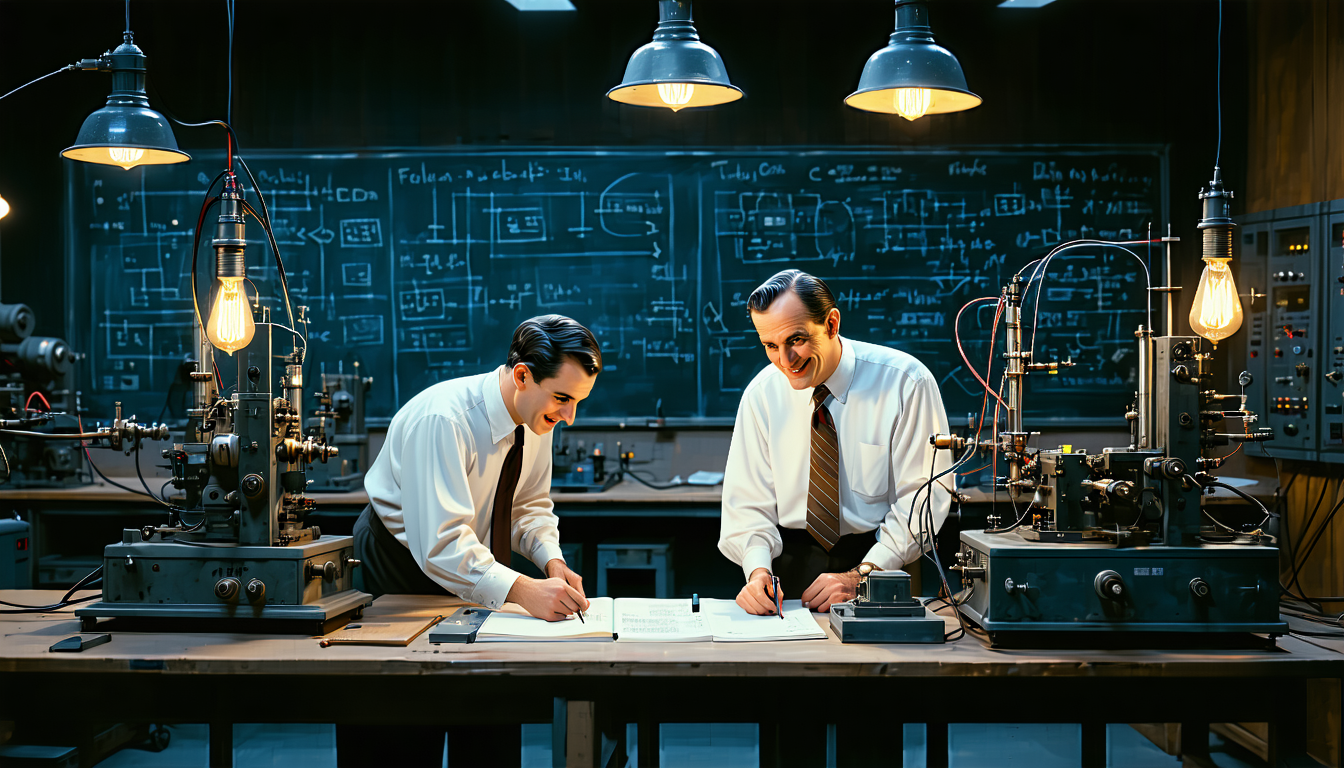
Invention of the Point-Contact Transistor
John Bardeen and Walter Brattain successfully demonstrate the first point-contact transistor, marking a breakthrough in semiconductor technology.
Setting
Bell Labs research laboratory in Murray Hill, New Jersey. A medium-sized room with workbenches covered in electronic components, oscilloscopes, and testing equipment. The walls are lined with chalkboards covered in equations and schematics.
Characters
The figures in this scene as an entity network — co-presence links everyone in the moment; speakers who trade lines are bound tighter. Turn the resolution dial to reveal depth the engine actually computed.
TNGF
SELECTED
John Bardeen
primary
A bespectacled man in his late 30s with a lean build and thinning dark hair combed neatly to the side. His intense focus is evident in the furrow of his brow and the slight pursing of his lips as he studies the experimental setup.
Walter Brattain
primary
A lean, middle-aged man with sharp features, wire-rimmed glasses perched on his nose, and slightly tousled dark hair. His hands are steady and precise, accustomed to handling delicate instruments.
William Shockley
secondary
A tall, lean man in his late 30s with sharp features, wire-rimmed glasses, and neatly combed dark hair. His piercing gaze conveys both intelligence and a calculating nature.
Lab Assistant
background
A young man in his mid-twenties, slight in build with short, neatly combed brown hair and wire-rimmed glasses. His hands are steady, accustomed to handling delicate equipment.
Dialog
John Bardeen
The germanium crystal's conductivity is responding as predicted. Current amplification at 1.3 volts appears stable.
Walter Brattain
Huh! This contraption's actually behaving—no, wait, let me dial back the bias to 0.9 volts. The gain curve should... yes, there.
John Bardeen
The contacts need micron-level precision. That gold foil spacing—another 0.05 millimeters should stabilize the electron flow.
Walter Brattain
We're getting twenty times signal amplification now. That's no fluke—these solid-state effects are real.
Chat with Characters
Causal neighbors · 385 linked moments
F
1948
· same figure
F
1948
· influences
F
1949
· same era
F
1949
· follows
F
1949
· same figure
F
1950
· same era
F
1950
· follows
I
1948
· same era
D
1946
· same era
D
1946
· precedes
I
1948
· follows
I
1948
· same location
I
1948
· same figure
F
1954
· same era
F
1954
· follows
C
1954
· same era
C
1954
· follows
C
1954
· same location
I
1958
· same figure
R
2018
· same figure
M
1948
· same figure
I
1947
· contemporaneous
I
1947
· same figure
G
1997
· same figure
M
1948
· same figure
D
1951
· same era
D
1951
· follows
T
1945
· same era
T
1945
· precedes
E
1946
· same era
E
1946
· precedes
I
1947
· contemporaneous
I
1947
· same location
I
1947
· same figure
M
1949
· same figure
E
1945
· same era