Manchester Baby First Run
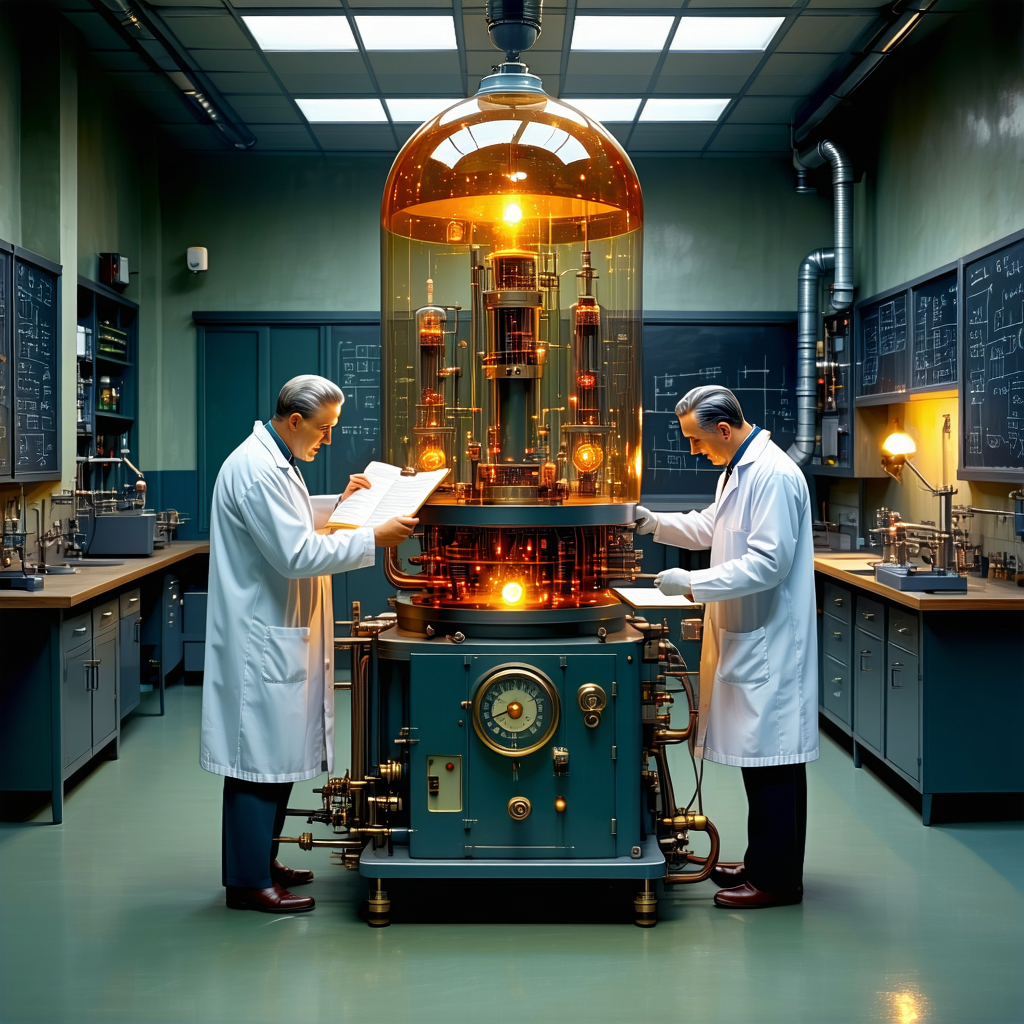
The Manchester Baby, the world's first stored-program computer, is about to execute its first successful program. The team of researchers, led by Frederic C. Williams and Tom Kilburn, watches intently
Setting
A small, cluttered laboratory in the University of Manchester's Electrical Engineering Department. The room is filled with workbenches, technical equipment, and chalkboards covered in equations and diagrams.
Characters
The figures in this scene as an entity network — co-presence links everyone in the moment; speakers who trade lines are bound tighter. Turn the resolution dial to reveal depth the engine actually computed.
TNGF
SELECTED
Frederic C. Williams
primary
A lean, middle-aged man of average height with sharp features, a high forehead, and thinning brown hair combed back. His wire-rimmed glasses reflect the laboratory lights as he works. His hands show the calluses of an engineer who works directly with equipment.
Tom Kilburn
primary
A lean man in his late twenties with sharp features, dark hair neatly combed back, and wire-rimmed glasses perched on his nose. His hands are stained with ink from hours of programming work, and there's a faint smudge of machine oil on his cheek.
Geoff Tootill
secondary
A lean man in his mid-20s with short, sandy hair kept neatly combed. His wire-framed glasses sit slightly askew on his nose, and his face bears the faint remnants of acne scars. His hands are calloused from frequent work with delicate electronics.
Lab Assistant
background
A young man in his early 20s, slight of build with neatly combed brown hair and wire-rimmed glasses. His face bears the focused intensity of someone deeply absorbed in technical work.
Dialog
Frederic C. Williams
The store appears stable, Tom. The spots aren't fading—you see, we've managed to hold the charge this time.
Tom Kilburn
Right. Now if the control interprets the program correctly... it should be executing the highest proper factor.
Frederic C. Williams
There! You see the deflection pattern? Just like radar echoes during the war—but this time we're storing numbers, not aircraft.
Tom Kilburn
The store's holding. That's 32 bits retained for... 2 minutes now. Far longer than we'd dared hope.
Frederic C. Williams
Let's run the full multiplication test. If this works, we'll have proven random-access storage is feasible, not just theoretically possible.
Tom Kilburn
Stand by... the Baby's cycling through the program. The display should show 262,144 if it's processed correctly.
Frederic C. Williams
By Jove... there it is! The first stored-program computer actually working. Not just an idea in a paper, but right there on the screen.
Chat with Characters
Causal neighbors · 209 linked moments
F
1948
· contemporaneous
A
1950
· same location
F
1948
· same figure
I
1947
· same figure
F
1949
· same figure
I
1948
· same figure
I
1958
· same figure
R
2018
· same figure
M
1948
· same era
I
1947
· same figure
M
1949
· same era
M
1949
· follows
M
1949
· same location
G
1997
· same figure
M
1948
· contemporaneous
M
1948
· same figure
E
1949
· same era
E
1949
· follows
E
1949
· same era
E
1949
· follows
I
1947
· same figure
M
1949
· same era
M
1949
· follows
M
1949
· same figure
M
1949
· same era
M
1949
· follows
A
1950
· same era
A
1950
· follows
I
1947
· same figure
F
1948
· contemporaneous
F
1948
· same location
F
1948
· same figure
C
1953
· same era
C
1953
· follows
C
1953
· same era
C
1953
· follows