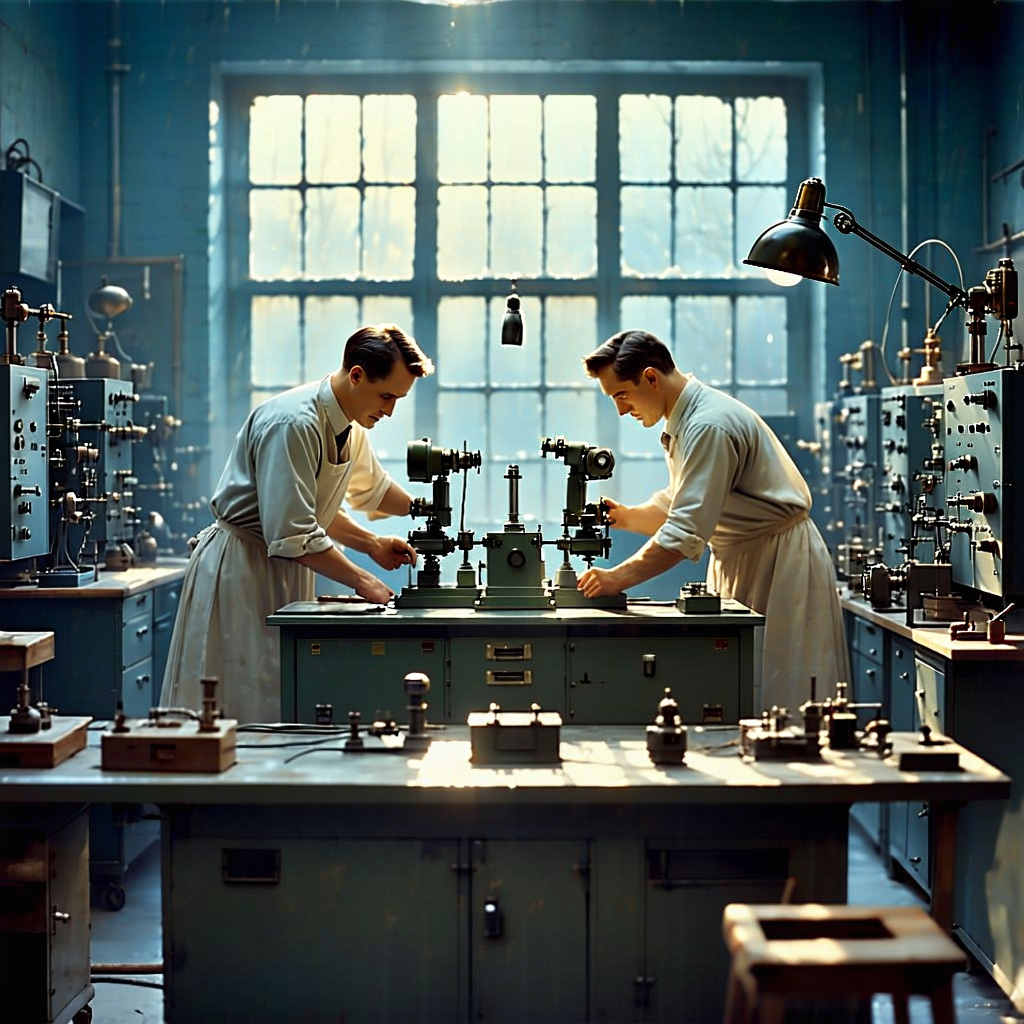
Invention of the Transistor
John Bardeen and Walter Brattain successfully demonstrate the first working transistor at Bell Labs, marking a breakthrough in semiconductor technology that replaces bulky vacuum tubes.
Setting
A research laboratory at Bell Labs in Murray Hill, New Jersey. The room is filled with scientific equipment, workbenches, and chalkboards covered in equations. Large windows let in the winter light, but the primary illumination comes from overhead fluorescent lights and desk lamps.
Characters
The figures in this scene as an entity network — co-presence links everyone in the moment; speakers who trade lines are bound tighter. Turn the resolution dial to reveal depth the engine actually computed.
TNGF
SELECTED
John Bardeen
primary
A middle-aged man in his late 30s, with a thoughtful gaze and slightly tousled dark hair. He wears round wire-rimmed glasses that catch the light as he works. His posture is slightly hunched from hours spent over equations, but there's a wiry strength in his frame.
Walter Brattain
primary
A lean, middle-aged man in his mid-40s with sharp features and short, neatly combed brown hair. His wire-rimmed glasses sit slightly askew on his nose as he squints at the equipment. His hands are steady and precise, showing years of experimental work.
William Shockley
secondary
A lean, middle-aged man with sharp features, receding hairline, and intense eyes behind round, wire-framed glasses. His posture is upright, conveying authority, and his hands are often clasped behind his back or gesturing precisely.
Lab Assistant
background
A young man in his early 20s, slight of build with short, neatly combed brown hair. His face is clean-shaven, and he wears round, wire-rimmed glasses that occasionally slip down his nose. His hands are slightly ink-stained from recording data.
Dialog
Walter Brattain
John, look at that gain—it's holding steady at 30 decibels. The germanium's behaving exactly as we predicted.
John Bardeen
Yes, but the current amplification is even more promising. If we can stabilize the feedback loop, we might just have our solid-state amplifier.
William Shockley
Gentlemen, let's not get ahead of ourselves. Theoretical predictions are one thing, but reproducibility is the cornerstone of scientific progress.
Walter Brattain
Reproducibility? Bill, we've replicated this three times now. The data doesn't lie.
John Bardeen
Walter's right. The consistency is remarkable. This could revolutionize electronics—no more vacuum tubes.
William Shockley
Indeed, but let's ensure the patent applications reflect the theoretical framework as much as the experimental results. Credit must be properly attributed.
Walter Brattain
Credit? Let's make sure it works first.
Chat with Characters
Causal neighbors · 179 linked moments
I
1947
· contemporaneous
I
1947
· contemporaneous
I
1947
· contemporaneous
I
1947
· same location
M
1949
· same figure
F
1949
· same figure
I
1958
· same figure
M
1948
· same figure
G
1997
· same figure
I
1947
· same figure
M
1948
· same figure
R
2018
· same figure
I
1947
· same figure
F
1948
· same figure
I
1948
· same figure
I
1947
· same figure
E
1946
· influences
F
1948
· same figure
F
1947
· contemporaneous
F
1947
· same location
F
1947
· same figure
E
1946
· same era
E
1946
· precedes
F
1969
· same figure
F
1991
· same figure
I
1947
· contemporaneous
I
1947
· same figure
M
1948
· same figure
F
1958
· same figure
F
1954
· same figure
F
1960
· same figure

1948
· same figure
I
1947
· contemporaneous
I
1947
· contemporaneous
I
1947
· contemporaneous
U
1951
· same era