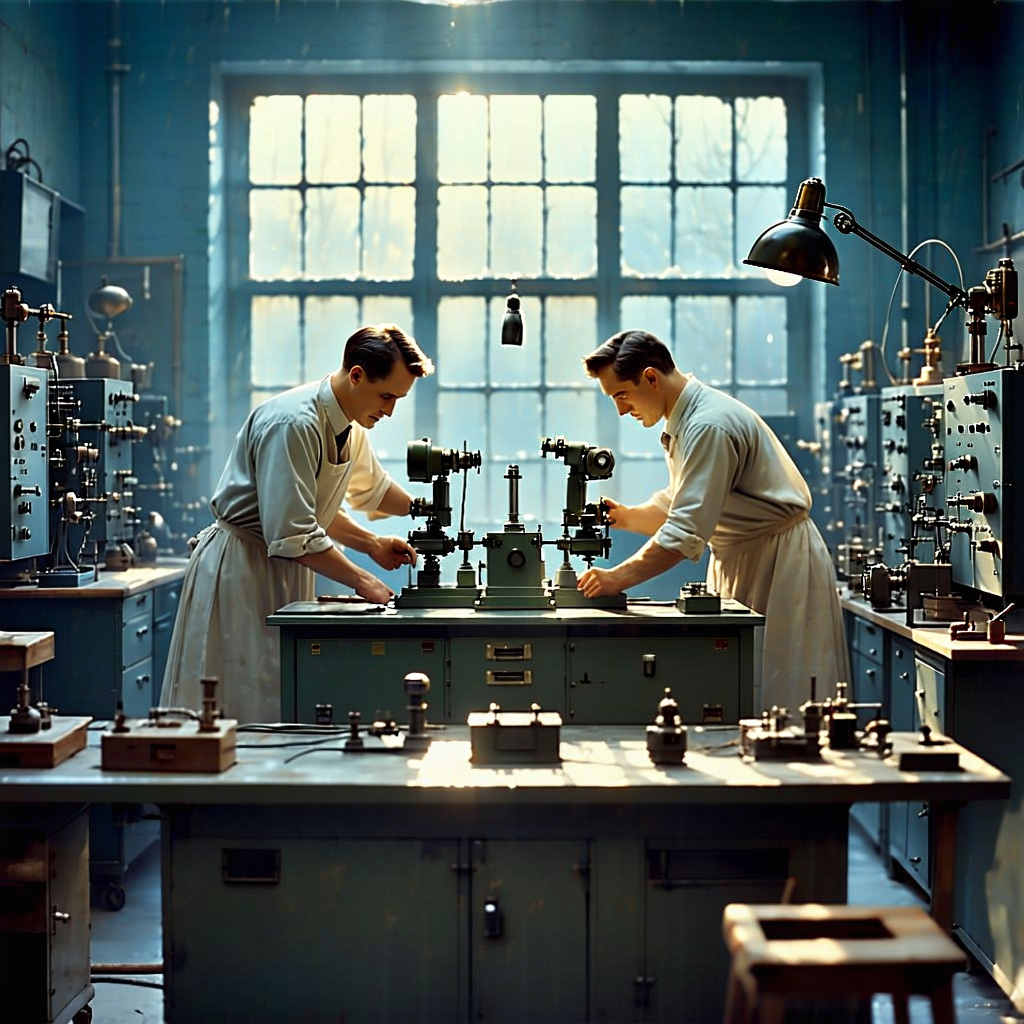
Invention of the Transistor
William Shockley, John Bardeen, and Walter Brattain are conducting a critical experiment to demonstrate the first working transistor, a device that could revolutionize electronics by replacing bulky v
Setting
Bell Labs research laboratory, Murray Hill, New Jersey. A pristine, white-walled room with linoleum flooring, filled with workbenches covered in electronic components and testing equipment. The space is dominated by a central table where the transistor experiment is being conducted.
Characters
The figures in this scene as an entity network — co-presence links everyone in the moment; speakers who trade lines are bound tighter. Turn the resolution dial to reveal depth the engine actually computed.
TNGF
SELECTED
William Shockley
primary
A middle-aged man in his late 30s, with a lean build and sharp features. His dark hair is neatly combed back, and his piercing eyes are framed by a pair of wire-rimmed glasses. His posture is rigid, reflecting his intense focus and authoritative demeanor.
John Bardeen
primary
A middle-aged man in his late 30s, slight in build with thinning dark hair combed neatly back. His wire-rimmed glasses reflect the laboratory lights as he peers intently at the equipment. His face bears the focused intensity of a man deep in thought, with faint lines of concentration around his eyes.
Walter Brattain
secondary
Middle-aged experimental physicist with a wiry frame, sharp features, and a keen, observant gaze. His hands are steady, accustomed to precise measurements and adjustments.
Lab Technician
secondary
A young man in his late 20s, of average height with a wiry frame. His short brown hair is neatly combed, and he wears round, wire-framed glasses that frequently slip down his nose. His hands are slightly calloused from handling delicate equipment.
Bell Labs Executive
background
A middle-aged man in his late 40s, with a sharp, angular face and a meticulously groomed appearance. He has a lean build, standing tall with an air of quiet authority. His piercing eyes silently observe the proceedings, betraying nothing of his inner thoughts.
Dialog
William Shockley
Bardeen, the readings are still inconsistent. Your hypothesis on surface states must be flawed.
John Bardeen
The data shows clear amplification, Shockley. We're seeing hole conduction in the germanium - just as predicted.
Lab Technician
Dr. Shockley, if you please - the bias voltage is holding steady at 90 volts now.
William Shockley
That crystal mount is still unstable. Brattain, are you certain about the gold foil contacts?
John Bardeen
Look here - the current gain is persisting. This isn't just amplification... we've achieved control.
Lab Technician
Good heavens... it's maintaining stable oscillation without vacuum tubes!
William Shockley
Don't celebrate yet. Document every parameter - history will judge this moment by our records.
Chat with Characters
Causal neighbors · 341 linked moments
I
1947
· contemporaneous
F
1947
· contemporaneous
I
1947
· contemporaneous
I
1947
· contemporaneous
I
1947
· contemporaneous
C
1954
· same location
P
1948
· same location
I
1947
· same location
I
1947
· same location
I
1948
· same location
P
1948
· same location
I
1957
· same figure
F
1947
· same figure
F
1950
· same figure
E
1949
· same figure
I
1958
· same figure
M
1965
· same figure
F
1960
· same figure
I
1947
· same figure
D
1958
· same figure
F
1954
· same figure
I
1947
· same figure
A
2017
· same figure
J
1958
· same figure
Z
1976
· same figure
P
1948
· same figure
I
1947
· same figure
I
1948
· same figure

1958
· same figure
I
1947
· same figure
C
1941
· influences
T
1945
· same era
T
1945
· precedes
E
1946
· same era
E
1946
· precedes
C
1942
· same era