ALPHA Timepoint is in alpha Talk to Us
I

Invention of the Transistor

John Bardeen and Walter Brattain successfully demonstrate the first working point-contact transistor, a revolutionary electronic device that amplifies and switches electrical signals without vacuum tu

Setting

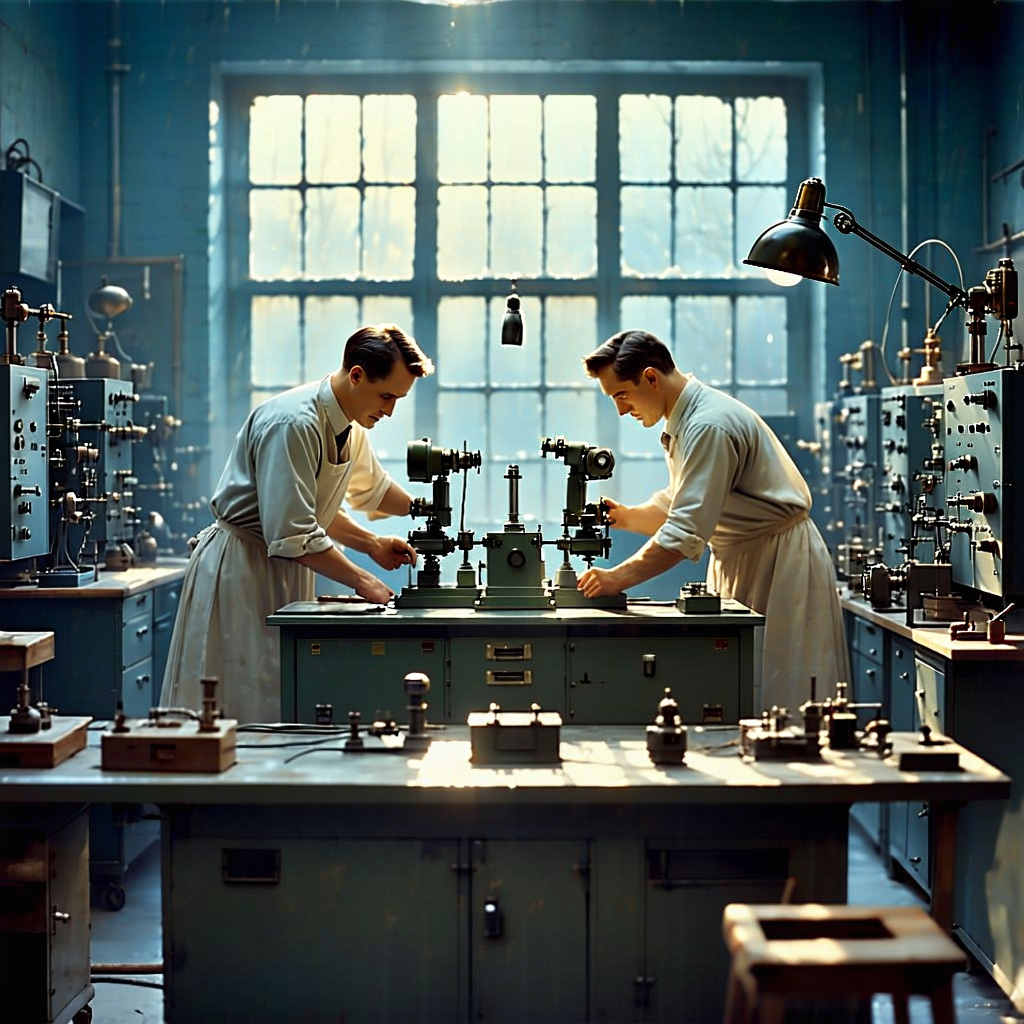
Laboratory room at Bell Labs in Murray Hill, New Jersey, featuring a large wooden workbench cluttered with electronic components, test equipment, and notebooks. The walls are lined with shelves filled with technical manuals, glassware, and prototype devices. A large chalkboard covered in equations and diagrams dominates one wall.

Characters

John Bardeen
primary
A lean, wiry man in his late 30s with sharp features, closely cropped dark hair, and intense, deep-set eyes that reflect a mind constantly at work. His hands are precise in their movements, bearing faint chemical stains from laboratory work.
Walter Brattain
primary
A lean, middle-aged man with sharp features, a receding hairline, and intense brown eyes. His hands are slightly calloused from years of meticulous lab work. He wears round, wire-rimmed glasses that reflect the harsh laboratory lighting.
William Shockley
secondary
A tall, lean man in his late 30s with sharp features, high forehead, and penetrating eyes behind round, wire-rimmed glasses. His posture exudes authority, and his movements are precise, reflecting his military background and scientific rigor.
Lab Assistant
background
A young man in his early 20s, slender but wiry from long hours in the lab. His dark brown hair is slightly tousled from repeatedly running his hands through it in excitement. He wears round, wire-framed glasses that keep slipping down his nose, which he pushes up absentmindedly. His hands bear faint chemical stains and small nicks from handling equipment.

Dialog

Walter Brattain John, look at that gain—nearly twentyfold at 10 megacycles. The germanium's surface potential is holding steady.
John Bardeen The phase shift is minimal too... if we adjust the point spacing by another micron, we might stabilize the amplification further.
William Shockley One might question whether such empirical tinkering advances the theoretical framework, rather than merely producing... favorable coincidences.
Walter Brattain Coincidences don’t produce repeatable 4.5-volt swings at the collector, Bill. The curves match our semiconductor theory, just not your junction hypothesis.
John Bardeen Walter, the current saturation here suggests minority carrier injection. That would explain the low noise floor...
Walter Brattain Christ, you’re right—it’s modulating the bulk resistance dynamically. This isn’t just amplification, it’s control.
William Shockley I’ll require full documentation of these... observations for my 4 PM review with the director.

Chat with Characters

You've used your 3 free turns

Sign in to keep chatting with characters from this moment — unlimited turns.

Sign in to Continue
Sign in for unlimited

Related Moments

I
Invention of the Point-Contact Transistor
1947 · contemporaneous
I
Invention of the Point-Contact Transistor
1947 · contemporaneous
Dartmouth Summer Research Project on Artificial Intelligence
1956 · same era
E
ENIAC Unveiled
1946 · same era
F
First Silicon Transistor Demonstration
1954 · same era
C
Completion of TRADIC, the First Transistor Computer
1954 · same era
P
Proposal for the Dartmouth Summer Research Project on Artificial Intelligence
1955 · same era
I
Invention of the Perceptron
1957 · same era