Dartmouth Summer Research Project on Artificial Intelligence
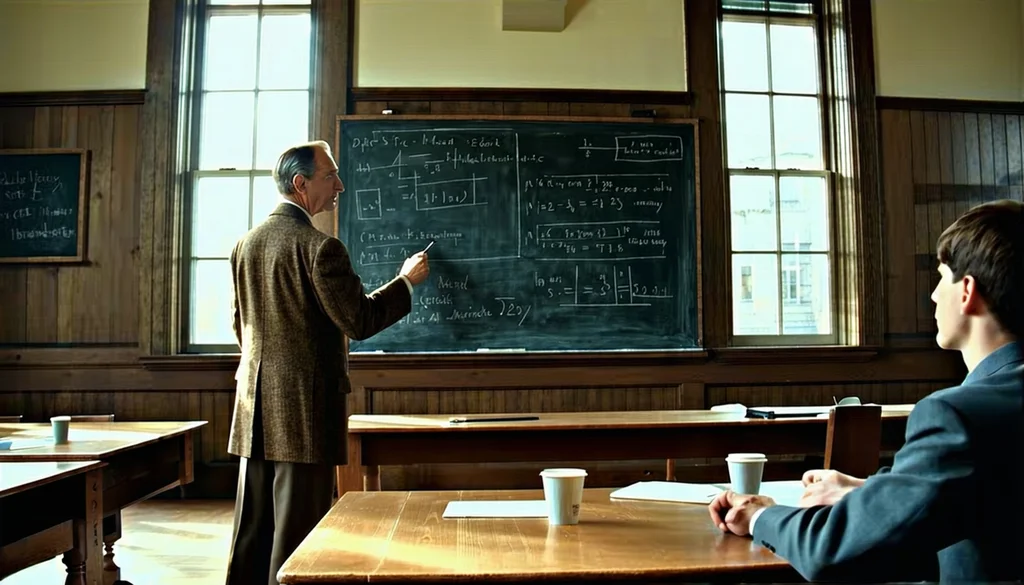
The Lead Researcher presents a groundbreaking hypothesis about machine learning to a gathering of top minds at the Dartmouth Summer Research Project, sparking heated debate about the feasibility of ar
Setting
A spacious, wood-paneled lecture hall at Dartmouth College, with large windows overlooking the lush green campus. The room is filled with rows of wooden chairs and desks, arranged in a semi-circle facing a chalkboard covered in mathematical equations and diagrams.
Characters
The figures in this scene as an entity network — co-presence links everyone in the moment; speakers who trade lines are bound tighter. Turn the resolution dial to reveal depth the engine actually computed.
TNGF
SELECTED
Lead Researcher
primary
A middle-aged man in his late 40s with a lean build, slightly receding hairline of dark brown hair streaked with gray, and sharp, penetrating eyes behind round wire-rimmed glasses. His face bears the faint lines of deep thought and frequent concentration.
Junior Scientist
primary
A lean young man in his late 20s with neatly combed brown hair and wire-rimmed glasses. His face bears the faint tan lines of someone who's spent summers outdoors, contrasting with the pallor of long library hours. His hands move with precise energy when explaining concepts.
Graduate Student
secondary
A young man in his early 20s with a slender build, short-cropped dark hair, and wire-rimmed glasses. His face is clean-shaven, and his posture is slightly hunched from hours of note-taking. He has an air of quiet intensity, with sharp eyes that dart between his notebook and the chalkboard.
Department Secretary
background
A professional woman in her late 30s with a neat, efficient appearance. She has a slender build, short wavy brown hair styled in a conservative manner, and wears round, wire-rimmed glasses. Her posture is upright, reflecting her disciplined work ethic.
Dialog
Lead Researcher
Gentlemen, this combinatorial explosion of possibilities—if you will—cannot be dismissed with mere probabilistic hand-waving!
Junior Scientist
With respect, Professor—if we consider Turing's 1948 paper on learning machines, the Manchester prototype demonstrates that threshold logic networks can—no, wait—
Lead Researcher
Demonstrates what, precisely? Asymptotic approach to... what? These 'neural' metaphors are charming, but completely lacking in rigorous—
Junior Scientist
McCulloch and Pitts proved in '43 that any computable function can be—
Lead Researcher
Proved? Those were toy models! We're discussing Turing-complete, completely Turing-complete systems here!
Junior Scientist
Then let me show you Rosenblatt's perceptron convergence theorem—the mathematics is sound, I've verified it thrice—
Lead Researcher
Mathematics without physical realization is just... beautiful philosophy!
Chat with Characters
Causal neighbors · 290 linked moments
E
1958
· same era
E
1958
· follows
D
1951
· same era
D
1951
· precedes
L
1958
· same era
L
1958
· follows
F
1962
· same era
F
1962
· follows
E
1946
· same era
E
1946
· precedes
I
1947
· same era
I
1947
· precedes
C
1958
· same era
C
1958
· follows
D
1956
· same era
D
1956
· follows
D
1956
· same location

1958
· same era
E
1958
· same era
E
1958
· follows
T
1962
· same era
T
1962
· follows
1958
· follows
D
1956
· same location
F
1949
· same figure
D
1956
· same location
D
1956
· same location
D
1956
· same location

1951
· same figure

1953
· same figure

1953
· same figure
F
1954
· same figure

1960
· same figure
S
1957
· same figure
P
1956
· same location
D
1956
· same location