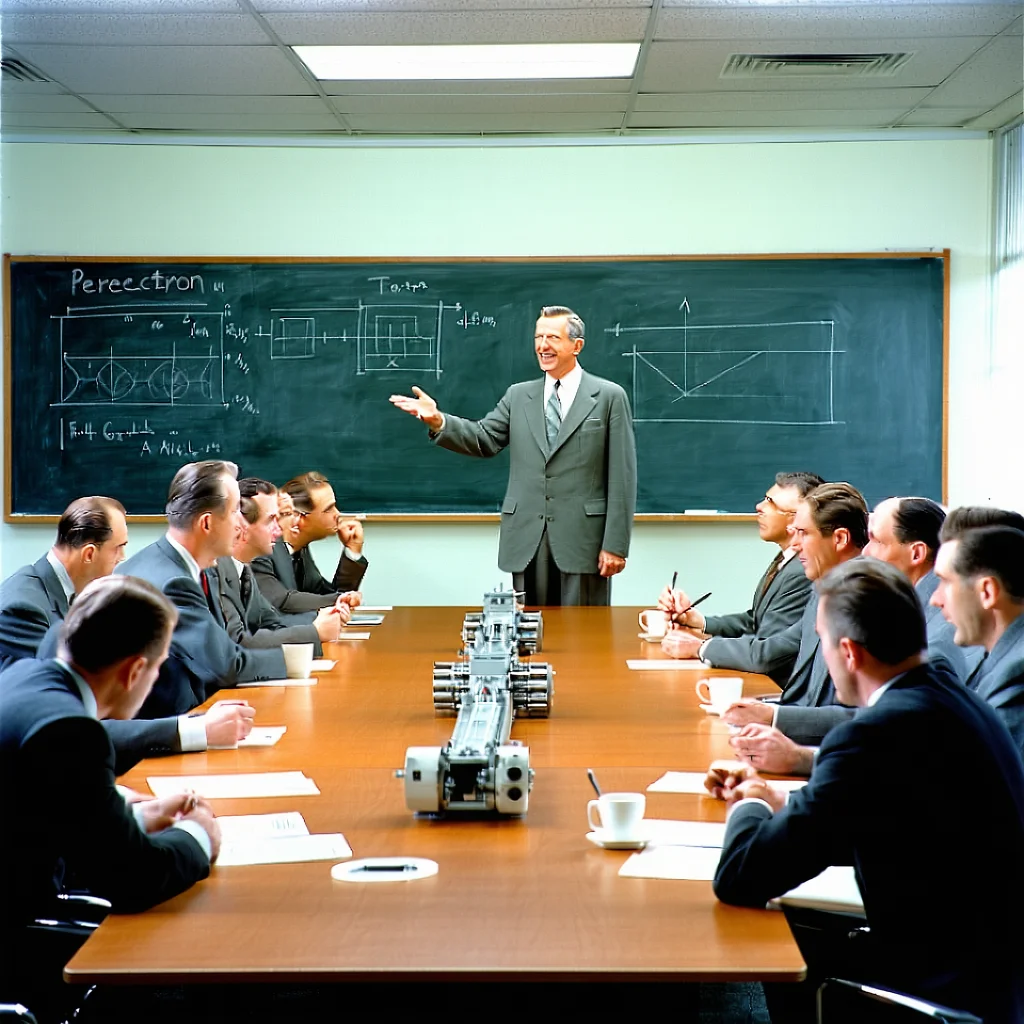
Dartmouth Workshop
The founding meeting of artificial intelligence research, where pioneers like John McCarthy, Marvin Minsky, and Claude Shannon debate the future of machine intelligence, defining the scope and goals o
Setting
A sunlit conference room in Dartmouth College's mathematics department, with large windows overlooking the campus green. The room is filled with wooden tables arranged in a semi-circle, surrounded by chairs occupied by some of the brightest minds in computer science and mathematics.
Characters
The figures in this scene as an entity network — co-presence links everyone in the moment; speakers who trade lines are bound tighter. Turn the resolution dial to reveal depth the engine actually computed.
TNGF
SELECTED
John McCarthy
primary
A lean man in his late 20s with sharp features, wire-rimmed glasses, and slightly tousled brown hair. His intense gaze reflects a mind constantly at work, and his posture suggests both academic rigor and youthful energy.
Marvin Minsky
primary
A slender man in his late 20s with a sharp, angular face, dark wavy hair combed neatly to the side, and piercing eyes that convey both intensity and curiosity. His posture is slightly hunched, as if constantly leaning into ideas.
Claude Shannon
secondary
A middle-aged man of average height with a lean build, sharp features, and a receding hairline. His piercing eyes reflect a keen intellect, and he sports a neatly trimmed mustache. His posture is relaxed yet attentive, exuding an air of quiet confidence.
Graduate Student
background
A young man in his mid-20s, with a lean build and short, neatly combed brown hair. His wire-rimmed glasses sit slightly askew on his nose as he focuses intently on his notes. His face is clean-shaven, and his posture is slightly hunched from hours of meticulous writing.
Dialog
John McCarthy
Let us formalize this as a computational problem: if a machine can modify its own code to improve performance based on experience, we may consider that the beginnings of learning.
Marvin Minsky
But consider this—if we model it as a network of simple threshold elements, like neurons firing, we don't need explicit programming at all! The learning emerges from the connections!
Claude Shannon
Like a switchboard that rewires itself based on which circuits are used most. The question is whether that's computation or something... else.
John McCarthy
From a computational standpoint, the key distinction is whether the machine's behavior can be predicted by analyzing its initial state and inputs—or if it develops true unpredictability.
Marvin Minsky
Unpredictability? That's just another word for complexity we haven't mapped yet! Give me enough relays and I'll show you a machine that surprises us daily!
Claude Shannon
Gentlemen, we're dancing around the real question: when does a complex system stop being a tool and start being... a colleague?
John McCarthy
Precisely why we must define 'artificial intelligence' rigorously—before the philosophers get hold of it and muddy the waters with metaphysics.
Chat with Characters
Causal neighbors · 285 linked moments
P
1955
· same location
D
1956
· same location
D
1956
· same location
D
1956
· same location
D
1956
· same location
D
1956
· same location
D
1956
· same location
1948
· same figure
P
1955
· same figure
1958
· same figure
C
1958
· same figure
D
1958
· same figure
D
1956
· same figure
P
1948
· same figure
D
1956
· same figure
J
1958
· same figure
1969
· same figure
D
1956
· same figure
D
1956
· same figure
1956
· same figure
F
1974
· influences

1947
· same era
1947
· precedes
1956
· same era
F
1954
· same era
C
1954
· same era
P
1955
· same era
I
1957
· same era
D
1958
· same era
D
1957
· same era
E
1959
· same era
P
1948
· same era
F
1962
· same era
E
1946
· same era
I
1947
· same era
M
1962
· same era