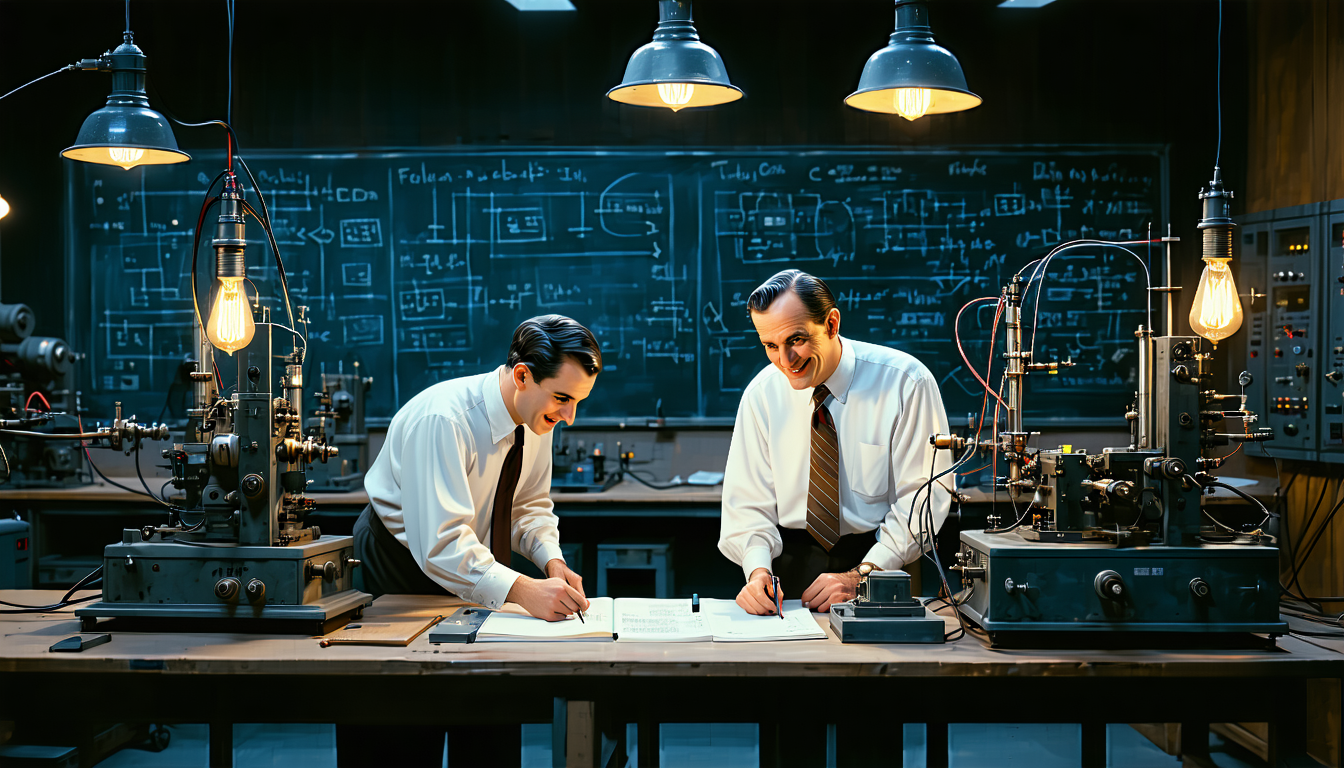
Invention of the point-contact transistor
John Bardeen, Walter Brattain, and William Shockley are demonstrating the first working point-contact transistor in a Bell Labs laboratory. The moment captures the precise instant when their experimen
Setting
Bell Labs laboratory, Murray Hill, New Jersey. A modest-sized room with workbenches covered in electronic components, oscilloscopes, and testing equipment. The walls are lined with chalkboards filled with equations and diagrams, and shelves stocked with tools and reference materials.
Characters
The figures in this scene as an entity network — co-presence links everyone in the moment; speakers who trade lines are bound tighter. Turn the resolution dial to reveal depth the engine actually computed.
TNGF
SELECTED
John Bardeen
primary
A middle-aged man of average height with a slender build, wearing round wire-framed glasses. His dark hair is neatly combed, and his face bears the focused intensity of a man deeply immersed in theoretical calculations. His hands are steady, accustomed to precise work.
Walter Brattain
primary
A lean, middle-aged man in his mid-40s with sharp features, wire-rimmed glasses perched on his nose, and short, neatly combed dark hair showing streaks of gray. His hands are steady and precise, betraying years of meticulous laboratory work.
William Shockley
secondary
A tall, lean man in his late 30s with sharp features, piercing eyes, and a receding hairline. His posture exudes authority, and his gaze is intense, reflecting his analytical mind.
Lab Technician
background
A young man in his early 20s, slight of build with short, neatly combed brown hair. His face is clean-shaven, and his hands are delicate yet steady, accustomed to handling precise instruments. He wears round, wire-framed glasses that occasionally slip down his nose.
Dialog
John Bardeen
The amplification factor appears stable at 4.5. Walter, can you confirm the voltage drop across the germanium?
Walter Brattain
She's holding steady at 0.1 volts—no, wait—there! See that jump? The contact's amplifying like we predicted.
John Bardeen
The quantum surface states are behaving as theorized. This isn't just noise—we're seeing carrier modulation.
Walter Brattain
Damn right it's not noise. That's 30% gain on the input signal. She's singing now, John.
John Bardeen
We'll need to replicate this with the n-type germanium. The symmetry suggests...
Walter Brattain
Later. Right now I want to see how far we can push her before saturation. Hand me the variable resistor.
Chat with Characters
Causal neighbors · 339 linked moments
F
1947
· contemporaneous
I
1947
· contemporaneous
I
1947
· contemporaneous
I
1947
· contemporaneous
I
1947
· contemporaneous
I
1947
· contemporaneous

1947
· contemporaneous
C
1954
· same location
P
1948
· same location
I
1947
· same location
I
1948
· same location
I
1947
· same location
P
1948
· same location
D
1960
· same location
I
1947
· same location
1947
· same location
F
1947
· contemporaneous
I
1947
· contemporaneous
I
1947
· contemporaneous
I
1947
· contemporaneous
I
1947
· contemporaneous
I
1947
· contemporaneous
1947
· contemporaneous
1956
· same era
F
1954
· same era
C
1954
· same era
P
1955
· same era
I
1957
· same era
D
1957
· same era
D
1956
· same era
P
1948
· same era
D
1956
· same era
E
1946
· same era
H
1944
· same era
E
1945
· same era
D
1956
· same era