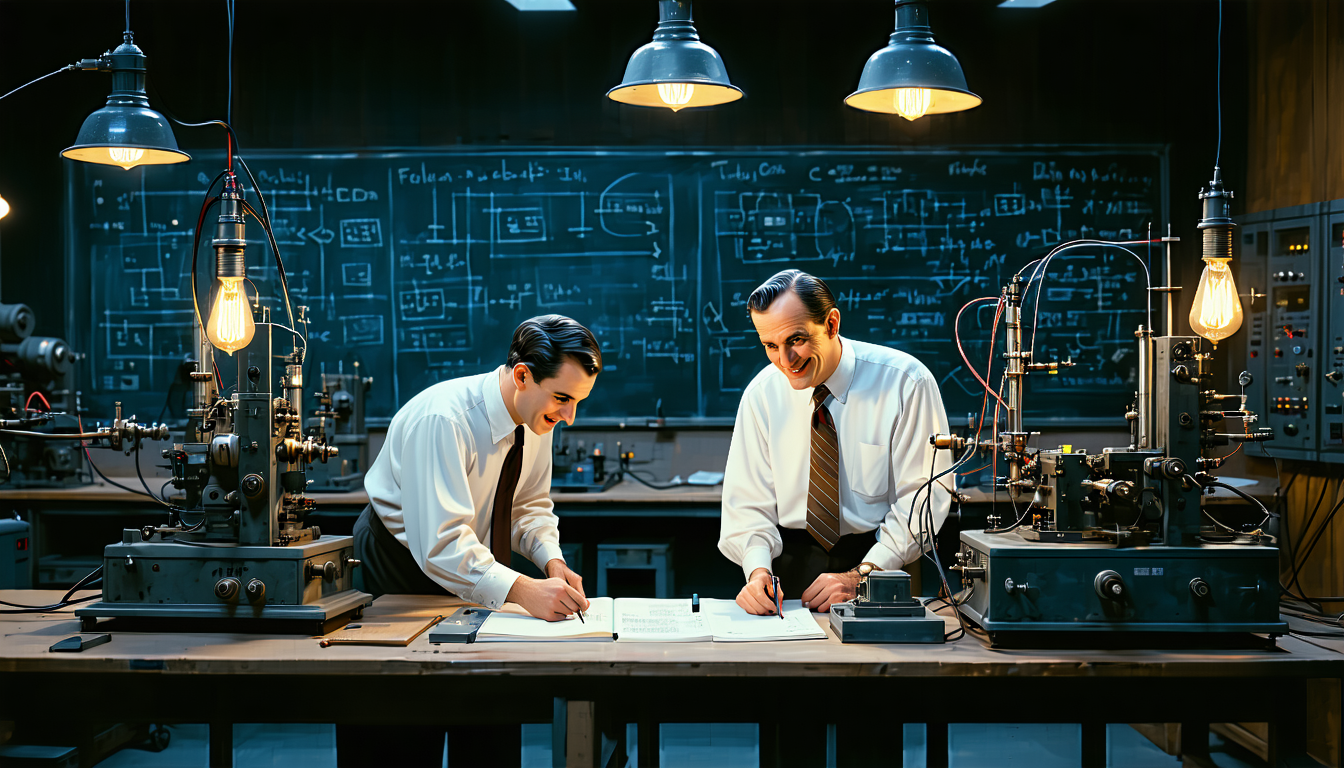
Invention of the Point-Contact Transistor
John Bardeen and Walter Brattain, under the supervision of William Shockley, are demonstrating the first working point-contact transistor, a revolutionary device that amplifies and switches electronic
Setting
A laboratory at Bell Labs in Murray Hill, New Jersey, filled with scientific equipment and workbenches. The room is orderly but crowded with experimental setups, chalkboards covered in equations, and shelves lined with tools and components.
Characters
The figures in this scene as an entity network — co-presence links everyone in the moment; speakers who trade lines are bound tighter. Turn the resolution dial to reveal depth the engine actually computed.
TNGF
SELECTED
John Bardeen
primary
A 39-year-old physicist of medium build with a thoughtful demeanor. He has a high forehead, thinning dark hair combed back, and wears round wire-rimmed glasses. His hands are precise and steady, accustomed to delicate experimental work.
Walter Brattain
primary
A lean, wiry man in his late 40s with sharp features, deep-set eyes, and thinning dark hair combed back. His hands are calloused from frequent experimentation, and his alert posture reveals both intensity and precision.
William Shockley
secondary
A lean, middle-aged man with sharp features, piercing eyes, and a receding hairline. His posture exudes authority, and his gaze is intensely analytical. He wears round, wire-framed glasses that catch the lab lights.
Lab Assistant
background
A young man in his mid-20s with a slender build, short dark hair neatly combed back, and wire-rimmed glasses perched on his nose. His face shows a mixture of youthful enthusiasm and professional restraint. His hands are slightly ink-stained from handling equipment and notes.
Dialog
John Bardeen
If we consider the surface states... the germanium’s electron configuration should... yes, that’s it.
Walter Brattain
Bias at 80 millivolts—contact spacing looks good. Output’s steady.
William Shockley
From a theoretical standpoint, this configuration should exhibit amplification. Proceed with the demonstration.
Walter Brattain
Damn straight it will. Like sanding a rough edge—just needed the right angle.
John Bardeen
The current gain—it’s holding. That’s... significant.
William Shockley
If the results are reproducible, this could redefine amplification theory. Document every parameter.
Walter Brattain
Hell, we’ve got it. Transistor’s working—no tubes, no filaments.
Chat with Characters
Causal neighbors · 343 linked moments
F
1947
· contemporaneous
F
1947
· contemporaneous
F
1947
· contemporaneous
I
1947
· contemporaneous
I
1947
· contemporaneous
I
1947
· contemporaneous
I
1947
· contemporaneous
I
1947
· contemporaneous
I
1947
· contemporaneous
I
1947
· contemporaneous

1947
· contemporaneous
I
1947
· contemporaneous

1947
· contemporaneous
F
1947
· contemporaneous
F
1947
· contemporaneous
F
1947
· contemporaneous
I
1947
· contemporaneous
I
1947
· contemporaneous
I
1947
· contemporaneous
I
1947
· contemporaneous
I
1947
· contemporaneous
I
1947
· contemporaneous
I
1947
· contemporaneous
1947
· contemporaneous
I
1947
· contemporaneous
1947
· contemporaneous
I
1947
· contemporaneous
I
1947
· contemporaneous
1956
· same era
F
1954
· same era
C
1954
· same era
P
1955
· same era
I
1957
· same era
P
1948
· same era
H
1944
· same era
E
1945
· same era