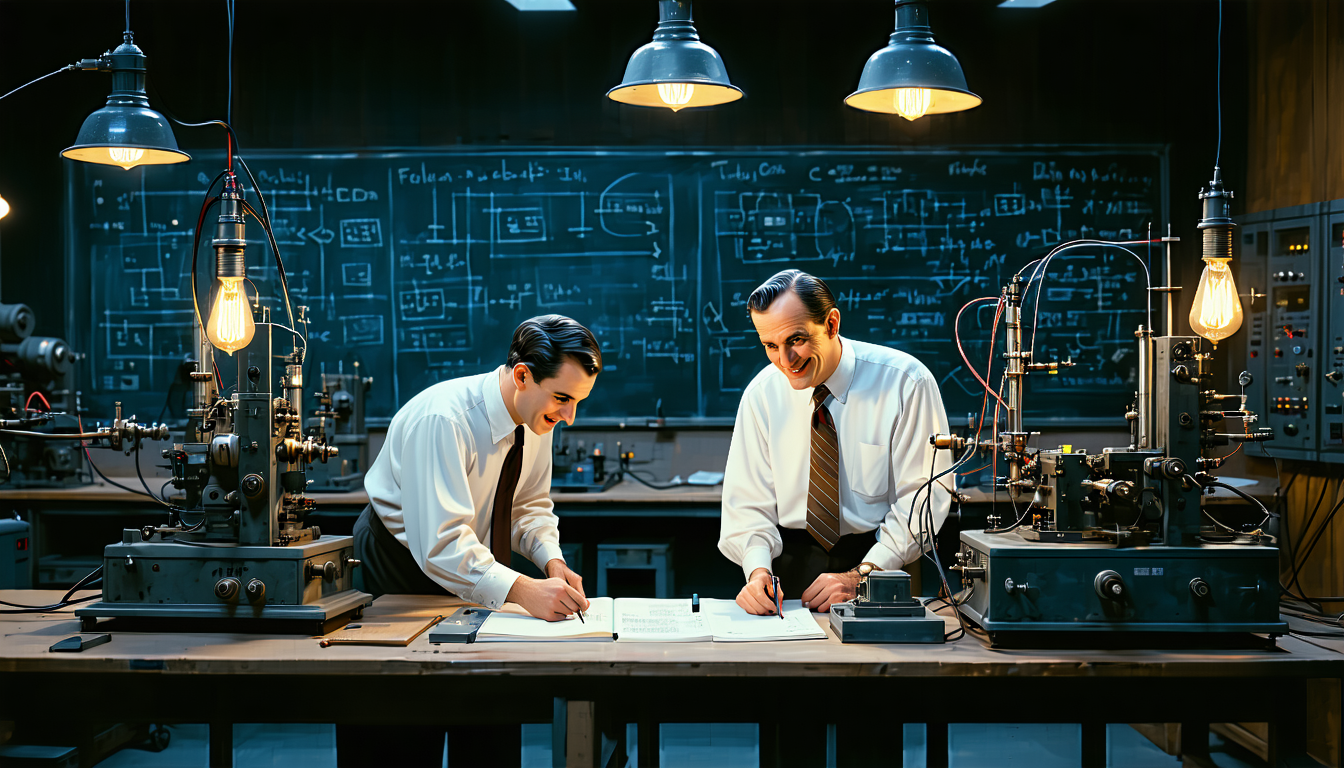
Invention of the point-contact transistor
Physicists John Bardeen and Walter Brattain demonstrate the first working point-contact transistor to their supervisor William Shockley and Bell Labs executives. Using a plastic wedge, gold foil, and
Setting
Bell Labs research laboratory in Murray Hill, New Jersey. A medium-sized lab room with workbenches, experimental setups, and scientific equipment. The space is cluttered with apparatus but organized with purpose. Large windows overlook a winter landscape outside.
Characters
The figures in this scene as an entity network — co-presence links everyone in the moment; speakers who trade lines are bound tighter. Turn the resolution dial to reveal depth the engine actually computed.
TNGF
SELECTED
John Bardeen
primary
A man of modest height with a slight, lean build and a quiet intellectual presence. He has thinning, dark hair combed neatly back, a high forehead, and deep-set, thoughtful eyes framed by thin-rimmed spectacles. His features are soft but set in a mask of intense concentration.
Walter Brattain
primary
A man of 45 with a sturdy, practical build and weathered, capable hands. He has a slightly receding hairline of dark hair and wears horn-rimmed spectacles that occasionally slide down his nose. His face is that of a tinkerer, lined with concentration and a quiet, unassuming intelligence.
William Shockley
secondary
A man of average height with a sharp, angular face and receding hairline. He has deep-set, piercing eyes behind thin-rimmed spectacles and a meticulously groomed appearance that suggests a preference for order and authority.
Lab Assistant
background
A young man in his mid-20s with a slender build, short brown hair neatly combed back, and round wire-rimmed glasses. His face bears the earnest expression of someone deeply invested in the scientific process but aware of his junior position.
Dialog
Walter Brattain
Now... just another fraction of a millimeter... there. John, watch the trace.
John Bardeen
Amplification factor... approximately 4.5. That's... significant.
William Shockley
Are you certain the contacts aren't forming a simple rectifier? The current gain must exceed unity beyond any experimental error.
Walter Brattain
Clear voltage gain across the contacts. See how the waveform shape changes—no rectification pattern.
John Bardeen
The surface states theory predicts this. The holes are migrating properly.
William Shockley
Run the frequency sweep again. If this holds across the spectrum, we may have—
Walter Brattain
We have it. By God, we've actually done it.
Chat with Characters
Causal neighbors · 343 linked moments
R
1954
· same era
F
1947
· contemporaneous
F
1947
· contemporaneous
F
1947
· contemporaneous
I
1947
· contemporaneous
I
1947
· contemporaneous
I
1947
· contemporaneous
I
1947
· contemporaneous
I
1947
· contemporaneous
I
1947
· contemporaneous
I
1947
· contemporaneous

1947
· contemporaneous
I
1947
· contemporaneous

1947
· contemporaneous
F
1947
· contemporaneous
F
1947
· contemporaneous
F
1947
· contemporaneous
I
1947
· contemporaneous
I
1947
· contemporaneous
I
1947
· contemporaneous
I
1947
· contemporaneous
I
1947
· contemporaneous
I
1947
· contemporaneous
I
1947
· contemporaneous
1947
· contemporaneous
I
1947
· contemporaneous
1947
· contemporaneous
I
1947
· contemporaneous
I
1947
· contemporaneous
I
1947
· contemporaneous
1956
· same era
F
1954
· same era
C
1954
· same era
P
1955
· same era
I
1957
· same era
P
1948
· same era